Case Study
Creating a Shared Behavioral Decision Model Across Products
Creating a Shared Behavioral Governance Model Across a Product Ecosystem
- Role: UX Manager / UX Lead
- Company: Yum! Brands
- Products: Coach ecosystem, Manager App, ARL, Web Admin
- Scope: ross-product behavioral governance, design quality systems, decision frameworks, operational UX
Focus Areas: Risk & Alert Handling, Decision Confirmation
Status: Phase 1 completed, pilot preparation in progress
Some details and visuals have been redacted or adapted to protect proprietary information. The case study emphasizes leadership approach and outcomes over exact designs.

Executive Summary
As Coach and adjacent Byte products continued to scale, similar operational situations were being handled differently across products, teams, and workflows.
What initially appeared as isolated UX inconsistencies revealed a broader organizational challenge: the absence of a shared behavioral model for handling risk, alerts, confirmations, and other high-impact operational interactions.
As initiative owner, I conducted a cross-product audit, identified recurring behavioral inconsistencies, and developed a lightweight governance framework designed to help teams make more consistent design decisions while reducing operational risk, duplicated effort, and cross-product fragmentation.
Rather than introducing another process, the goal was to create a shared decision-making system that could be integrated into existing workflows and design reviews.
CHALLENGE
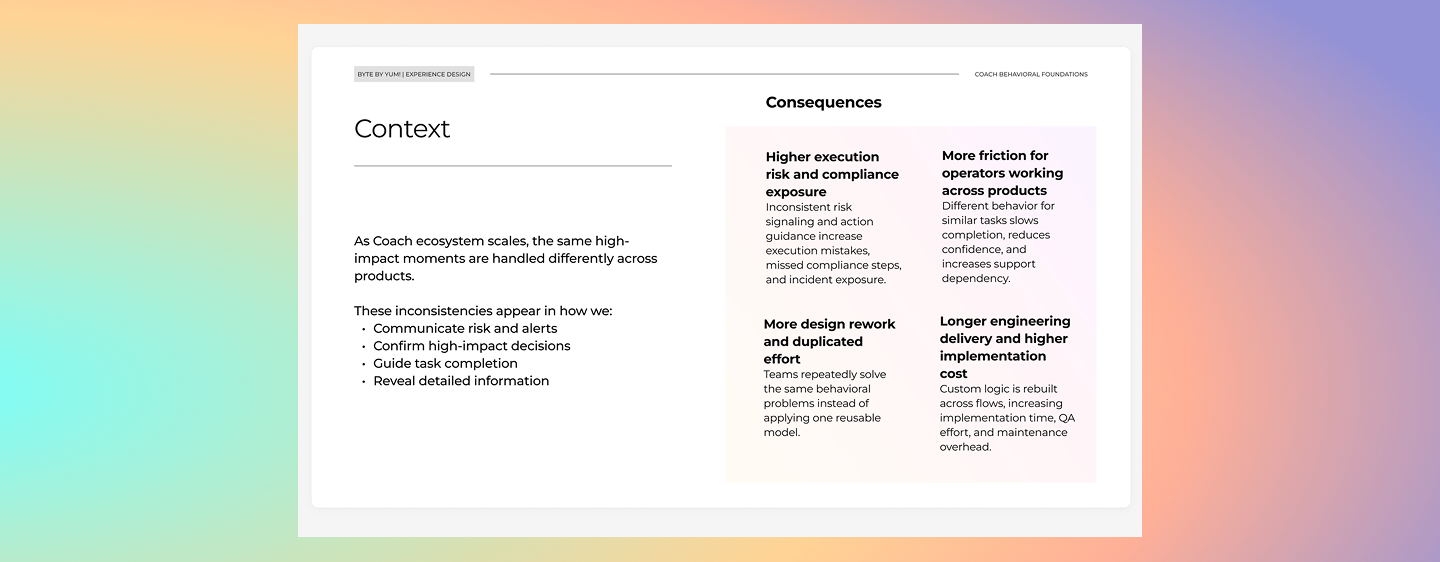
As the product ecosystem grew, similar operational situations were being handled differently across products and teams.
Alerts, confirmations, and other high-impact interactions evolved independently over time, creating inconsistent user experiences, repeated design effort, and unnecessary engineering complexity.
What initially appeared to be a UX consistency issue revealed a broader challenge: the absence of a shared behavioral model for making product decisions. To understand the scale of the problem, I conducted a cross-product audit and identified 11 recurring inconsistency themes across Risk & Alert Handling and Decision Confirmation.
The challenge was not improving individual screens. It was creating a lightweight governance model that could help teams make more consistent decisions while reducing operational risk and duplicated effort.
The audit identified 11 recurring inconsistency themes across two critical areas: Risk & Alert Handling and Decision Confirmation.
The challenge was no longer simply improving individual user flows. The challenge was creating a shared behavioral model that could help teams make more consistent decisions, reduce operational risk, and scale product quality across the ecosystem.
Why It Matters
At scale, behavioral inconsistency becomes more than a UX issue. It increases operational risk, creates compliance exposure, drives duplicated effort, and makes product ecosystems harder to learn and maintain.
Why Existing Approaches Didn't Work
Existing design systems helped standardize UI components, but they did not provide guidance for behavioral decisions.
Teams still needed to determine how the system should communicate risk, when confirmation was required, how severe a situation was, and what type of response users should receive.
As a result, similar operational scenarios continued to be implemented differently across products despite using many of the same components.
The challenge was not component consistency. It was behavioral consistency.
My Role
I initiated and led the Behavioral Foundations initiative.
My role included identifying the problem, conducting the ecosystem audit, defining the behavioral governance model, creating the decision framework, and driving alignment across design leadership and product partners.
Beyond the framework itself, I was responsible for ensuring the approach could scale across teams without introducing unnecessary process or reducing team autonomy.
Discovery: Identifying Systemic Behavioral Patterns
Rather than starting with components or design patterns, I focused on behavioral consistency.
I reviewed real product flows across multiple Coach products, including:
- Alerts and risk communication.
- Confirmation dialogs.
- Blocking workflows.
- Error states.
- Corrective actions.
The audit identified 11 recurring inconsistency themes across two high-impact categories:
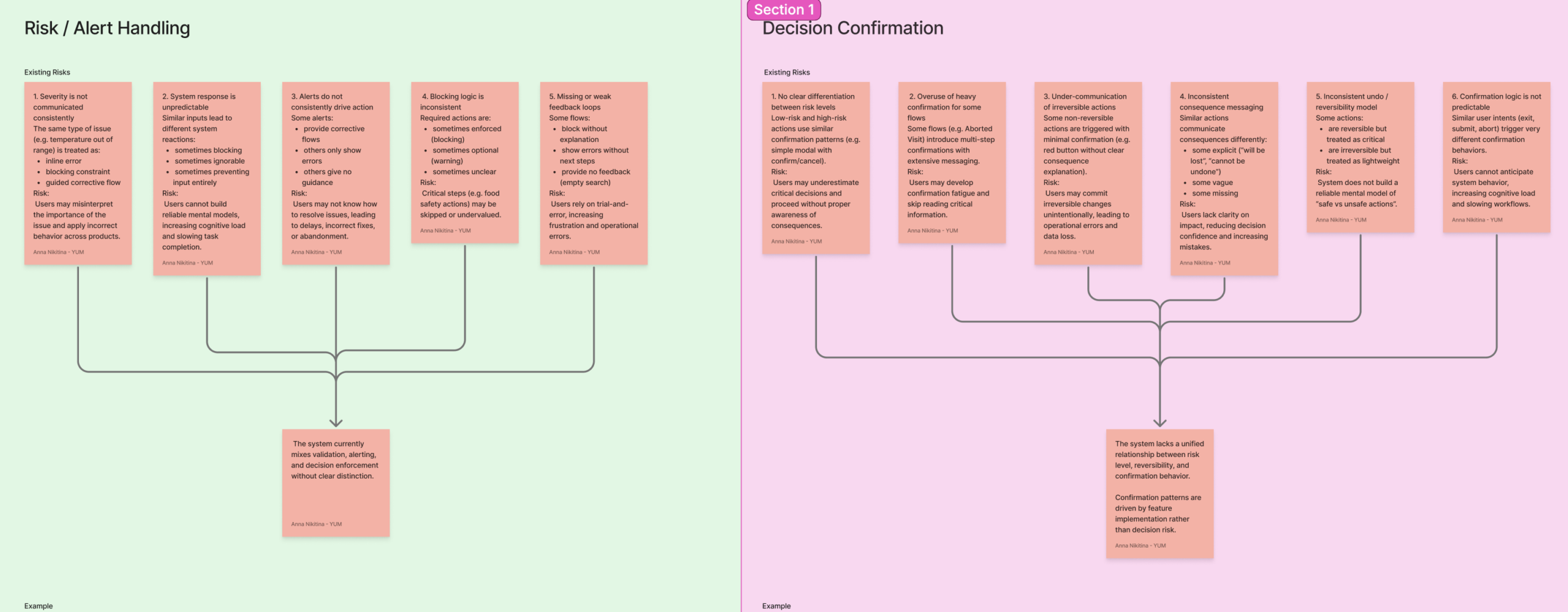
Risk & Alert Handling
Examples included:
- Similar risks communicated with different severity levels.
- Inconsistent blocking behavior.
- Missing guidance after errors.
- Unclear escalation paths.
Decision Confirmation
Examples included:
- Similar actions triggering different confirmation patterns.
- Overuse of heavy confirmations.
- Under-communication of irreversible actions.
- Inconsistent recovery options.
The analysis revealed a larger pattern: teams lacked a shared model for determining how the system should behave in critical moments.
Defining the Behavioral Foundations Model
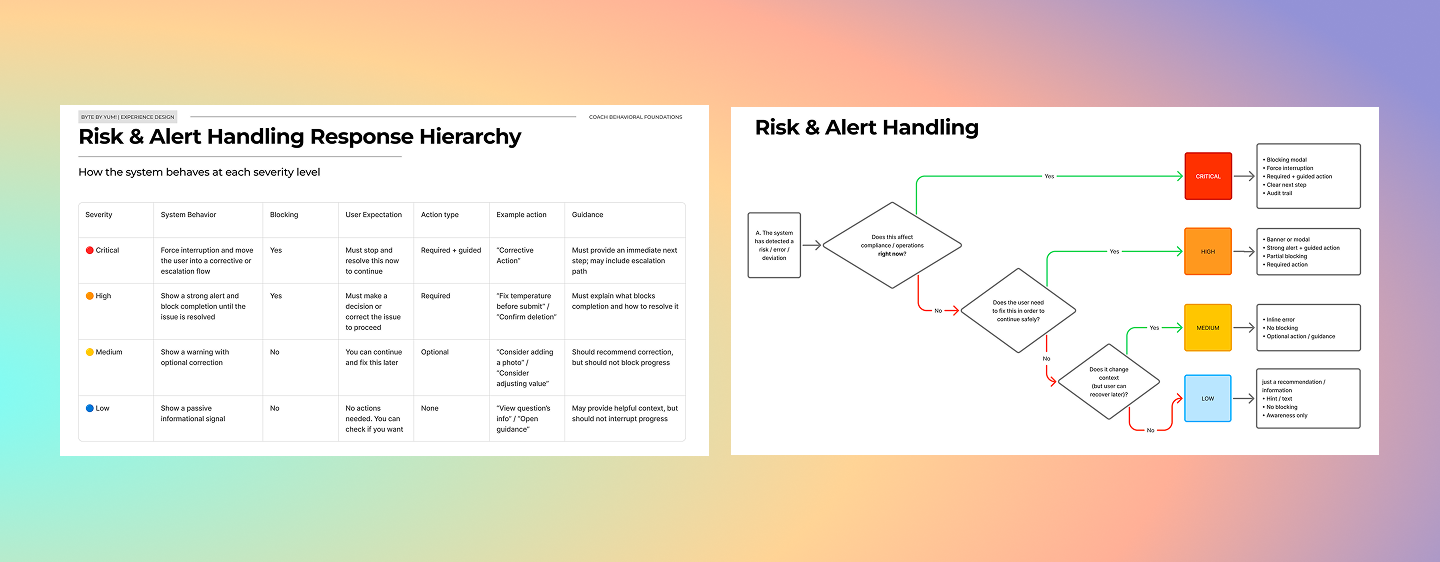
I created a decision framework that helps teams determine the appropriate behavior based on user risk and operational impact.
Phase 1 focused on two foundational areas:
Risk & Alert Handling
Defines:
- Severity levels.
- Escalation logic.
- Blocking behavior.
- Corrective action guidance.
- User expectations.
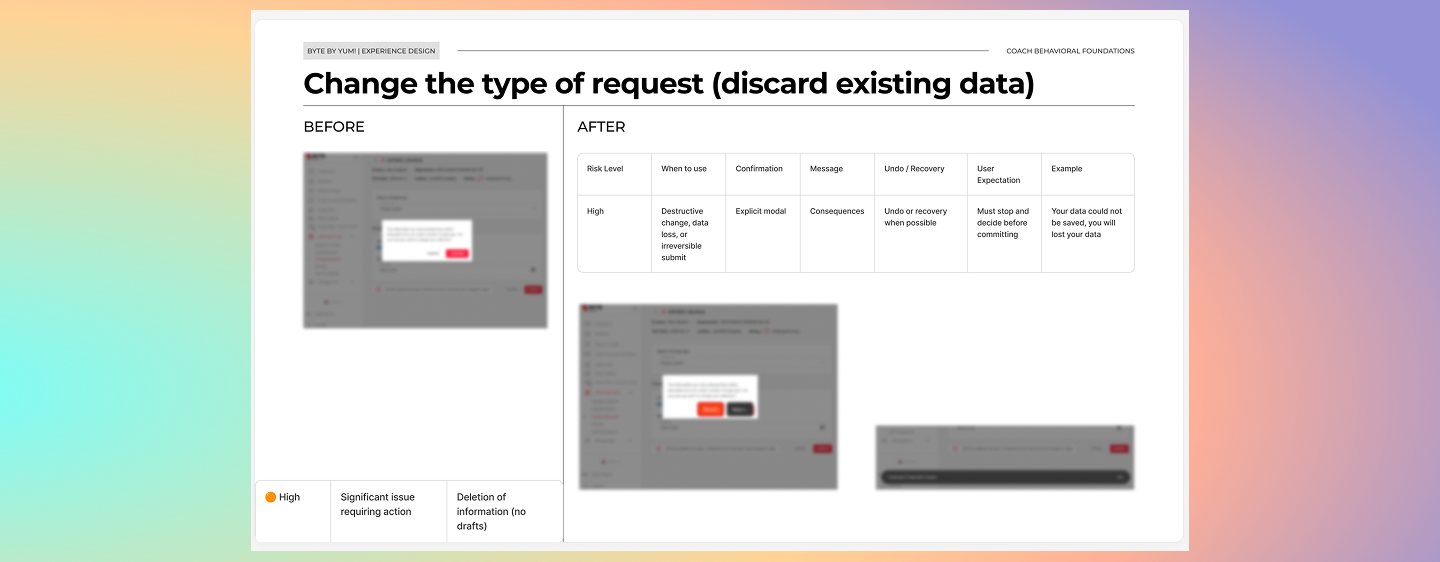
Decision Confirmation
Defines:
- When confirmation is required.
- Level of confirmation needed.
- Recovery expectations.
- Consequence communication.
- Decision risk handling.
The framework translates abstract UX discussions into practical decision trees and reusable behavioral rules.
Making Adoption Lightweight
One of the biggest risks was creating additional process overhead.
To avoid this, the framework was intentionally designed to fit existing workflows.
The adoption strategy includes:
- Integration into existing design reviews.
- Reference during mid-fidelity design stages.
- Shared examples and guidance.
- Lightweight discussion prompts instead of formal approvals.
The goal is not to enforce uniform solutions.
The goal is to help teams make more consistent decisions while preserving flexibility.
Early Signals
Although the initiative is still in its early stages, several encouraging signals emerged during review and alignment.
Feedback from design leadership and product teams highlighted:
- 11 recurring inconsistency themes identified across products.
- Shared severity model agreed upon by design leadership.
- Governance approach reviewed with design team and leadership partners.
- Framework selected for pilot integration into future high-risk initiatives.
The framework is currently positioned for pilot implementation within upcoming high-risk initiatives.
What I Learned
The most challenging part of this initiative was not defining the framework itself.
It was balancing consistency with usability for internal teams.
A framework only succeeds if people are willing to use it. Creating something lightweight, practical, and easy to adopt proved just as important as solving the underlying UX problem.
This work reinforced that design leadership is often less about creating solutions and more about creating systems that help organizations make better decisions repeatedly.
What's Next
Behavioral Foundations represents the first workstream within a broader Product Experience Foundations initiative.
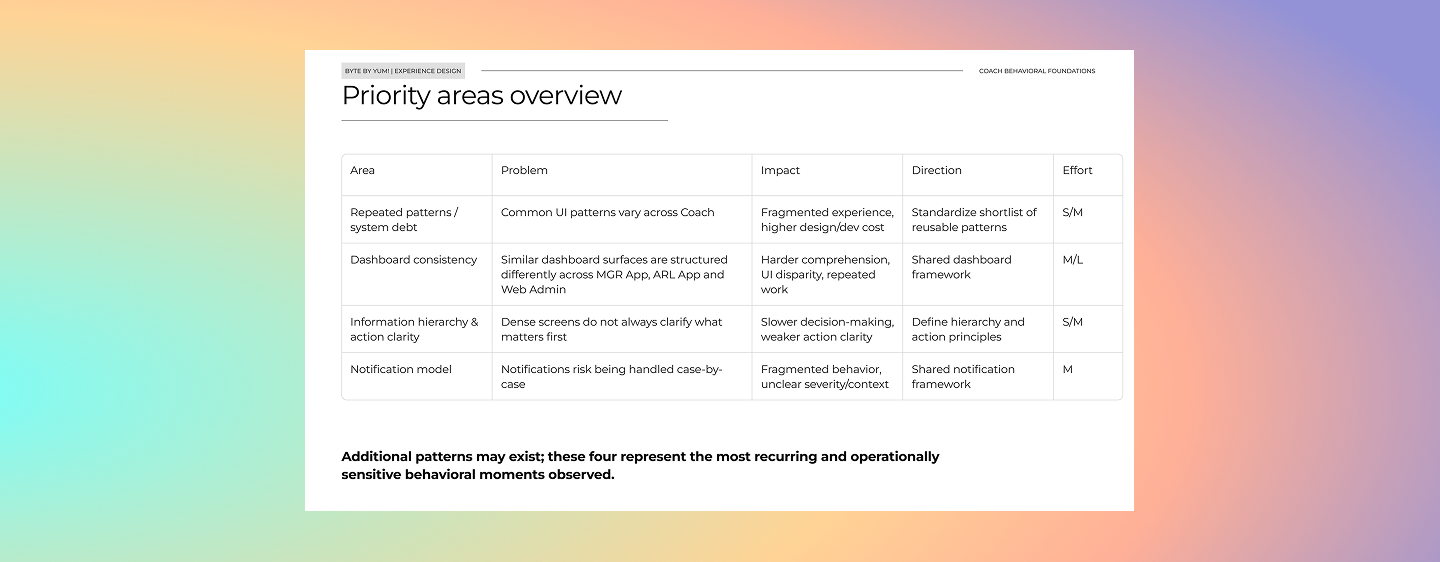
While Phase 1 focuses on Risk & Alert Handling and Decision Confirmation, the long-term vision is to establish shared decision frameworks across additional areas, including notifications, information hierarchy, dashboard consistency, and reusable interaction patterns.
The goal is to create a scalable system that helps teams make more consistent product decisions while reducing duplicated effort and improving experience quality across the ecosystem.